
How Loud Is a Whole-Home Generator?
Standby generator noise levels explained, decibel ratings, placement rules, and how to keep neighbors happy when you install a whole-home generator in Lexington, KY.
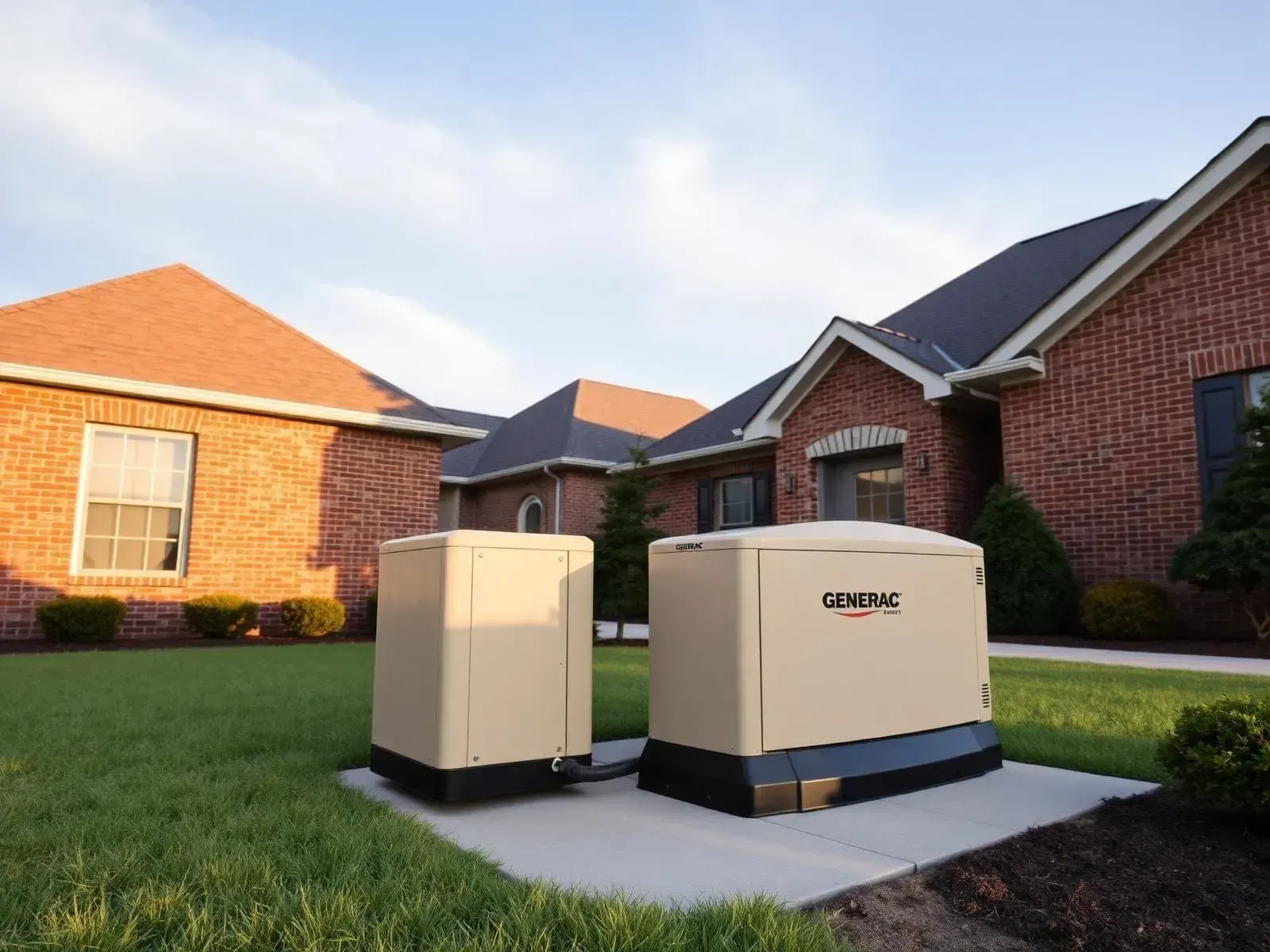
Noise is one of the top concerns homeowners raise before committing to a standby generator. The short answer: a properly placed whole-home generator runs at roughly the volume of a normal conversation, present, but not intrusive. The longer answer depends on the model, where it sits on your property, and how it is mounted. If you are planning a whole-home generator installation in Lexington or Central Kentucky, here is what to expect and how to keep noise to a minimum.
What the numbers actually mean
Generator manufacturers rate noise in decibels (dB) measured at a set distance, usually 23 feet. A few reference points: 60 dB is a normal conversation, 70 dB is a busy restaurant, and 85 dB is heavy traffic. Most residential air-cooled standby generators in the 18-26 kW range fall between 66 and 72 dB at that 23-foot distance.
Decibels are logarithmic, so a 3 dB difference is perceived as roughly twice as loud. That makes model selection and placement both matter, a unit rated 69 dB is noticeably louder than one rated 66 dB at the same distance.
- 66-68 dB: quieter air-cooled models (Generac Guardian, Honeywell standby lines)
- 69-72 dB: standard residential air-cooled units at full load
- Below 65 dB: liquid-cooled commercial-grade units, quieter but oversized for most homes
Placement is your most powerful noise control
The single most effective way to reduce generator noise in a neighborhood is placing the unit as far from property lines, windows, and outdoor living areas as the gas line and transfer switch wiring allow. Sound diminishes quickly with distance, a generator that reads 70 dB at 7 feet drops to roughly 58 dB at 23 feet.
During site visits in Lexington, we look at prevailing wind direction, proximity to neighbors' bedrooms, and outdoor patio placement. Generators exhaust hot air from the back of the unit, orienting that exhaust away from the house and toward open space also reduces heat and noise inside the home.
Lexington setback and noise guidelines
Lexington-Fayette Urban County Government requires permits for standby generator installations and enforces residential noise limits. Specific setback requirements are confirmed at permit time, but most installations need the unit at least 18 inches from the house per manufacturer requirements, and additional clearance from property lines per local code.
The permit process also covers gas line sizing and electrical transfer switch requirements. We handle permits for every generator installation in Lexington, homeowners are not required to manage permit applications themselves.
Anti-vibration pads and mounting
Generator vibration transfers into concrete pads and then into the ground, which can amplify low-frequency hum perceived inside adjacent structures. Anti-vibration isolation pads placed between the generator frame and the concrete slab decouple that vibration path. This is a low-cost addition during installation, it is far harder to add after the fact.
We use anti-vibration mounts on all our residential installations. If you are getting quotes, ask whether isolation pads are included.
Exercise cycles and when neighbors notice
Standby generators run a weekly self-test exercise cycle, typically 12 minutes at a preset time. Most manufacturers default this to a weekday morning. We recommend scheduling exercises mid-morning on a weekday rather than early Saturday, which is when neighbors are most likely to be outdoors. The exercise cycle is far shorter than an actual outage run, but picking a thoughtful time reduces friction with nearby properties.
Fuel type and noise
Natural gas and propane generators of the same kW rating produce similar noise levels, fuel type is not a significant noise variable. The bigger differentiator is engine technology: air-cooled units run their cooling fan continuously under load, contributing to noise, while liquid-cooled units are quieter because coolant handles thermal management instead of airflow. For most Lexington homes, an air-cooled unit in the 66-69 dB range is a reasonable and cost-effective choice.
For help choosing between fuel types, see our post on natural gas vs. propane generators in Kentucky.
When to consider a quieter model
If your home sits on a smaller lot, shares a fence line with a close neighbor, or has outdoor living spaces near where the generator would logically go, it is worth paying a modest premium for a model in the 66-68 dB range rather than a standard 70-72 dB unit. The difference in upfront cost is often a few hundred dollars, and it avoids years of neighbor friction.
Homes with large lots, natural screening such as dense shrubs, fences, or grade changes, or favorable siting often do fine with standard units. We discuss the tradeoffs on every site visit.
What to ask your installer
Before signing a contract, ask your installer these questions to make sure noise is handled properly from the start:
- What is the dB rating of this specific model at 23 feet, at rated load?
- Does the quote include anti-vibration isolation pads?
- Where exactly will the unit be placed, and how far from my neighbor's property line?
- Will you handle the permit and confirm setback compliance?
- Can I adjust the exercise cycle time and day after installation?
Schedule a site visit
We serve Lexington, Nicholasville, Georgetown, Winchester, and surrounding Central Kentucky communities. A site visit lets us identify the quietest placement option for your property before we pull permits. Contact us to schedule, or explore financing options if you want to spread the cost over time. Members of our Cool & Cozy Club receive priority scheduling and annual generator maintenance reminders.
Frequently Asked Questions
- How loud is a whole-home standby generator?
- Most air-cooled standby generators in the 18-26 kW range produce 66-72 decibels at 23 feet, roughly the volume of a normal conversation or a window air conditioner. Quieter models and proper placement can reduce perceived noise significantly.
- Does Lexington have noise ordinances that affect generator placement?
- Lexington-Fayette Urban County Government follows Kentucky noise guidelines that limit continuous mechanical noise in residential zones. Placement at least five to ten feet from property lines and away from bedroom windows keeps most installations in compliance. Your installer should verify current setback requirements at permit time.
- What is the quietest whole-home generator available?
- Generac's Guardian and Honeywell's air-cooled standby lines are among the quietest residential generators available, operating around 66 dB at rated load. Liquid-cooled units are even quieter but are sized for larger loads. Ask your installer for the specific dB rating of the model you're considering.
- Can I soundproof my generator?
- Aftermarket enclosures and anti-vibration pads can reduce generator noise, but they must never restrict airflow or violate the manufacturer's clearance requirements. A better strategy is proper site placement during initial installation, distance from the house and neighboring structures is the most effective noise control available.
Get a free generator estimate in Lexington
Licensed, veteran-owned technicians serving Lexington and Central Kentucky — free estimates, no pressure.
Learn moreHave questions about your home?
Talk to a licensed Lexington technician — no pressure, just answers.