
Does Your Lexington Business Need a Commercial Generator?
What size standby generator Lexington businesses actually need, which industries benefit most, and how to build a reliable backup power plan in Central KY.
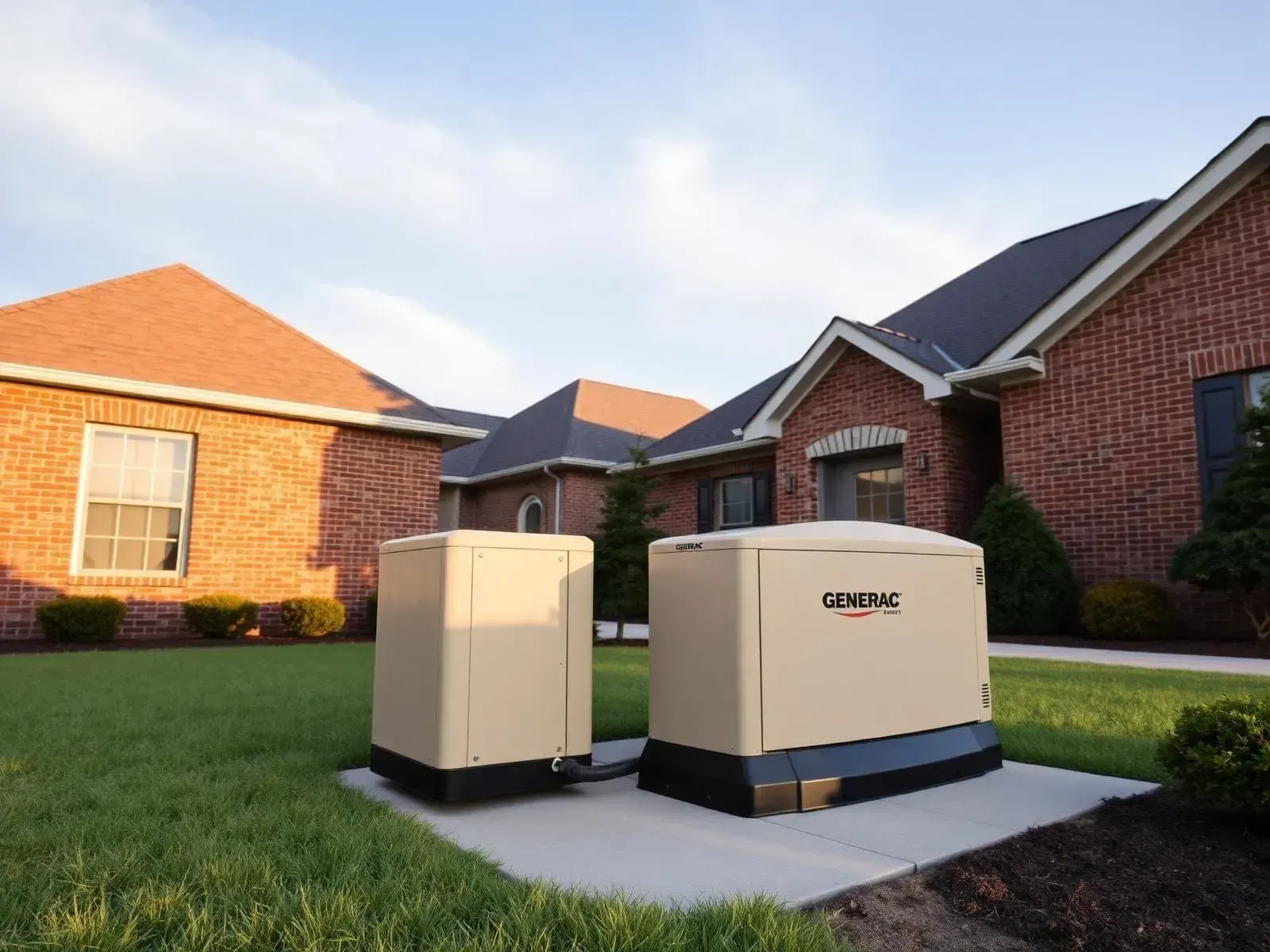
A power outage lasting four hours costs a restaurant its dinner service. The same outage shuts down a medical office, stops a retail point-of-sale system, and spoils a food service operation's refrigerated inventory. For Lexington businesses, Central Kentucky's ice storms, summer thunderstorms, and grid events are not hypothetical, they happen every year. A commercial standby generator eliminates that exposure. This guide covers what Lexington business owners need to know before buying.
For a site-specific assessment, contact our team, we handle commercial generator installations across Fayette County and surrounding Central Kentucky.
Which Lexington businesses need backup power most
Every business faces some disruption during an outage, but certain industries face direct financial or safety consequences within minutes. These are the operations we see most often requesting commercial generator assessments in Central Kentucky:
- Restaurants and food service, refrigeration, fryers, POS systems, and kitchen ventilation all go dark
- Medical and dental offices, electronic health records, refrigerated vaccines, and patient scheduling
- Retail stores, POS terminals, security cameras, and inventory climate control
- Gyms and fitness centers, HVAC, showers, and electronic equipment
- Auto shops and service centers, lifts, compressors, and diagnostic tools
- Hotels and short-term rentals, guest safety, lighting, and HVAC throughout a building
- Data-sensitive offices, servers, VoIP phone systems, and network hardware
How commercial generator sizing works
Commercial generator sizing starts with a load calculation, a line-by-line inventory of every circuit you need to protect. This is not the same as a residential calculation. Commercial buildings often have three-phase HVAC units, commercial refrigeration compressors, and dedicated equipment circuits that run at higher amperage. Undersizing creates a generator that overloads and shuts down the moment your AC compressor kicks on, which defeats the purpose entirely.
Most small commercial buildings in Lexington fall in the 30 kW to 100 kW range. A hair salon or small office might need 30 to 40 kW. A mid-size restaurant with commercial refrigeration and a full HVAC system often lands at 60 to 80 kW. A larger retail operation or medical practice with significant server infrastructure may need 100 kW or more. We run a formal load calculation before recommending any equipment.
Air-cooled vs. liquid-cooled commercial generators
Residential standby generators are almost universally air-cooled units rated at 10 to 26 kW. Commercial applications above 25 kW typically call for liquid-cooled generators, which use an integrated coolant system similar to a car engine. Liquid-cooled units run quieter, handle sustained high loads better, and last longer under the kind of continuous operation a multi-day outage demands.
For Lexington businesses, Generac's commercial line and Kohler's industrial units are the most common choices. Both are available in natural gas and propane configurations. We install and service both brands, explore generator installation to see what we offer.
Natural gas vs. propane for commercial applications
Lexington businesses with access to LG&E natural gas lines almost always choose natural gas for standby generators. The reasons are straightforward: natural gas supply is continuous, there is no tank to fill, and there is no risk of running out of fuel during a prolonged outage. Commercial generators on natural gas can run for days without any intervention.
Businesses on the outskirts of Lexington or in rural Fayette County without gas service use propane. A commercial propane setup requires a large tank, often 500 to 1,000 gallons, and a fuel contract with a local propane supplier to ensure adequate reserves heading into storm season. We help businesses in both scenarios plan accordingly.
Commercial transfer switches and code compliance
A commercial generator without a properly sized automatic transfer switch (ATS) is not a complete backup power system. The ATS monitors utility power, detects an outage, and switches the building load to the generator within seconds, all automatically. For commercial applications, the ATS is sized to handle the full load of the building and must comply with NEC requirements for commercial electrical systems.
Lexington commercial installations require a permit from the Division of Building Inspection and coordination with LG&E or Kentucky Utilities for meter base work. These are not optional steps, and skipping them creates liability and insurance exposure. Our team handles permit applications and utility coordination as part of every commercial install.
What installation involves for a Lexington business
Commercial generator installation in Lexington generally involves five major steps: load calculation and equipment selection, site preparation and concrete pad installation, equipment placement and anchoring, gas line and electrical connections, and utility coordination for the meter base. Each step has lead time, concrete pads need to cure, equipment has to be ordered and delivered, and utility appointments take scheduling.
Plan for two to four weeks from contract signing to operational generator, depending on equipment availability and utility scheduling. Starting the process before storm season, not during it, puts you in the best position.
- Concrete pad: poured and cured before generator placement
- Gas line: run from service entry to generator pad by a licensed plumber or HVAC contractor
- Transfer switch: mounted at main electrical panel or subpanel
- Electrical connections: wired by a licensed electrician under permit
- LG&E or KU coordination: required for any utility meter base modifications
Ongoing maintenance for commercial generators
A commercial standby generator runs an automatic weekly self-test to confirm it will start under load. That test does not replace scheduled maintenance. Commercial generators need oil and filter changes on the manufacturer's schedule, coolant checks for liquid-cooled units, battery testing, and load bank testing annually to confirm the unit will carry its rated load under real conditions.
Many Lexington businesses put their generator on a service contract to keep maintenance documented and warranty claims supported. If you have a residential generator at home, our Cool and Cozy Club maintenance membership covers HVAC maintenance on a planned schedule, ask about commercial service agreements when you call.
What a commercial generator costs in Lexington
Commercial generator pricing depends on the load you need to back up, the fuel source, whether the unit is air-cooled or liquid-cooled, and the transfer switch setup. A small office and a restaurant with walk-in coolers can need very different systems, so we price every commercial project after a site assessment.
Financing is available for commercial equipment. Request a free estimate or review our financing options.
Ready to protect your Lexington business?
We install and service commercial standby generators throughout Lexington, Nicholasville, Georgetown, Winchester, and surrounding Central Kentucky communities. Our licensed electricians handle load calculations, permits, utility coordination, and installation from start to finish.
Contact us to schedule a commercial load assessment. We will give you a straightforward recommendation and a detailed quote, no pressure, no guesswork.
Frequently Asked Questions
- Do small businesses in Lexington need a standby generator?
- Any business that handles perishable inventory, serves customers on-site, relies on electronic equipment, or provides safety-critical services can lose significant revenue during even a brief outage. A standby generator protects that revenue and keeps operations running without manual intervention.
- What size generator does a small commercial building need?
- A small commercial building in Lexington typically needs between 25 kW and 150 kW depending on HVAC load, lighting, refrigeration, and critical equipment. A licensed electrician performs a load calculation to determine the correct size before any equipment is purchased.
- How is a commercial generator installation different from residential?
- Commercial installations involve larger equipment, three-phase power in many cases, code compliance with commercial electrical codes, and more complex transfer switch configurations. Permits from the City of Lexington and coordination with LG&E or Kentucky Utilities are required.
- How long does it take to install a commercial generator in Lexington?
- A straightforward commercial standby generator installation in Lexington takes two to five business days depending on equipment size, concrete pad curing, gas line work, and utility coordination. Larger projects with significant electrical infrastructure may take longer.
Request a commercial generator quote in Lexington
Licensed, veteran-owned technicians serving Lexington and Central Kentucky — free estimates, no pressure.
Learn moreHave questions about your home?
Talk to a licensed Lexington technician — no pressure, just answers.